
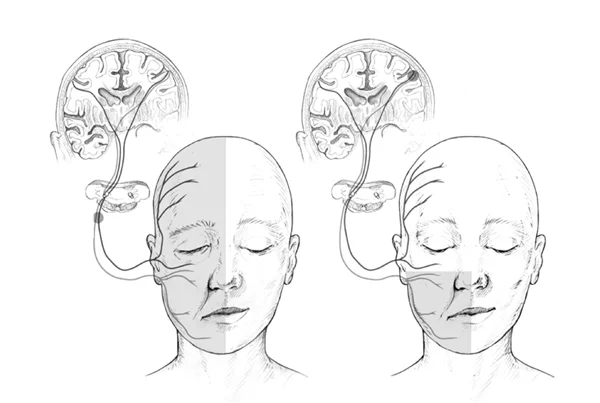
| Category | Nerve Conduction Study |
FACIAL
Measures muscle activity by detecting electrical impulses(face) Facial electromyography (FEMG) refers to an electromyography (EMG) technique that measures muscle activity by detecting and amplifying the tiny electrical impulses that are generated by muscle fibers when they contract.
The facial nerve (the labyrinthine segment) is the seventh cranial nerve, or simply CN VII. It emerges from the pons of the brainstem, controls the muscles of facial expression, and functions in the conveyance of taste sensations from the anterior two-thirds of the tongue.[1][2] The nerves typically travel from the pons through the facial canal in the temporal bone and exit the skull at the stylomastoid foramen.[3] It arises from the brainstem from an area posterior to the cranial nerve VI (abducens nerve) and anterior to cranial nerve VIII (vestibulocochlear nerve).
The facial nerve also supplies preganglionic parasympathetic fibers to several heads and neck ganglia.
The path of the facial nerve can be divided into six segments:
1. intracranial (cisternal) segment
2. meatal (canalicular) segment (within the internal auditory canal)
3. labyrinthine segment (internal auditory canal to geniculate ganglion)
4. tympanic segment (from geniculate ganglion to pyramidal eminence)
5. mastoid segment (from pyramidal eminence to stylomastoid foramen)
6. extratemporal segment (from stylomastoid foramen to post parotid branches)
The motor part of the facial nerve arises from the facial nerve nucleus in the pons, while the sensory and parasympathetic parts of the facial nerve arise from the intermediate nerve.
From the brain stem, the motor and sensory parts of the facial nerve join together and traverse the posterior cranial fossa before entering the petrous temporal bone via the internal auditory meatus. Upon exiting the internal auditory meatus, the nerve then runs a tortuous course through the facial canal, which is divided into the labyrinthine, tympanic, and mastoid segments.
The labyrinthine segment is very short and ends where the facial nerve forms a bend known as the geniculum of the facial nerve (genu meaning knee), which contains the geniculate ganglion for sensory nerve bodies. The first branch of the facial nerve, the greater petrosal nerve, arises here from the geniculate ganglion. The greater petrosal nerve runs through the pterygoid canal and synapses at the pterygopalatine ganglion. Postsynaptic fibers of the greater petrosal nerve innervate the lacrimal gland.
In the tympanic segment, the facial nerve runs through the tympanic cavity, medial to the incus.
The pyramidal eminence is the second bend in the facial nerve, where the nerve runs downward as the mastoid segment. In the temporal part of the facial canal, the nerve gives rise to the nerve to the stapedius muscle and chorda tympani. The chorda tympani supplies taste fibers to the anterior two-thirds of the tongue, and also synapses with the submandibular ganglion. Postsynaptic fibers from the submandibular ganglion supply the sublingual and submandibular glands.
Upon emerging from the stylomastoid foramen, the facial nerve gives rise to the posterior auricular branch. The facial nerve then passes through the parotid gland, which it does not innervate, to form the parotid plexus, which splits into five branches (temporal, zygomatic, buccal, marginal mandibular, and cervical) innervating the muscles of facial expression.
Intracranial branches
The greater petrosal nerve arises at the superior salivatory nucleus of the pons and provides parasympathetic innervation to several glands, including the nasal glands, the palatine glands, the lacrimal gland, and the pharyngeal gland. It also provides parasympathetic innervation to the sphenoid sinus, frontal sinus, maxillary sinus, ethmoid sinus, and nasal cavity. This nerve also includes taste fibers for the palate via the lesser palatine nerve and greater palatine nerve.


