
| Category | Evoked Potential |
VEP- (VISUAL EVOKED POTENTAIL)
A visual evoked potential or visual evoked response (VEP or VER) is a test that measures the integrity of the optical pathway from your eyes to the occipital lobe of your brain. It is used to determine if there is any damage to this pathway that may be causing certain visual symptoms.
WHAT IS A VEP?
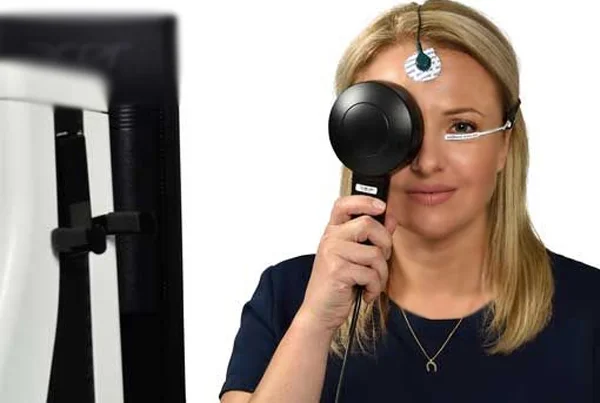
Visual Evoked Potentials (VEPs) testing measures the signals from your visual pathway. Small gold cups called electrodes are pasted to your head to allow us to record those signals. Just like in a regular eye exam, it is necessary to check how each eye works on its own.
WHAT IS A VEP USED FOR?
VEPs are used primarily to measure the functional integrity of the visual pathways from the retina via the optic nerves to the visual cortex of the brain. VEPs better quantify the functional integrity of the optic pathways than scanning techniques such as magnetic resonance imaging (MRI).
HOW IS VEP DONE?
How is the Diopsys® VEP vision test done? A technician will clean and dry three small areas on your head, and then place sensory pads on the cleansed areas. The technician will ask you to cover one eye at a time while the VEP vision test is being run.
WHAT CAUSES VEP?
Factors influencing VEP
Your gender, age, and the size of your pupils are other factors that can affect the VEP. If you have taken any drugs that make you drowsy, or under the influence of any anesthetic drugs, your VEP is also greatly affected.
WHAT DOES A NORMAL VEP LOOK LIKE?
A normal VEP response to a pattern-reversal stimulus is a positive peak that occurs at a mean latency of 100 ms. There are three separate phases in the VEP waveform: an initial negative deflection (N70), a prominent positive deflection (P100), and a later negative deflection (N155).
WHAT DOES P100 MEAN IN VEP?
The VEP is the waveform evoked from the occipital cortex after visual stimulation. The P100 is the name of the waveform measured using scalp occipital electrodes, time-locked to visual stimulation. It is usually a large positive deflection at approx 100 ms after stimulation, hence the name P100.
WHAT IS NORMAL P100 LATENCY?
A P100 latency change of up to at least 11 msec needs to be acknowledged as normal when assessing the clinical significance of changes in P100 latencies in patients. Also, P100 latency changes greater than 11 or 12 msec are very suggestive of an abnormality in the visual pathway.


